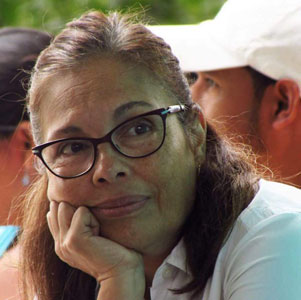
Valentina Martinez, M.A.
Archaeologist/Instructor/Ecuador Field School Director
Office: SO 182, Phone: 561-297-0991, E-Mail: vmartine@fau.edu
M.A., , 1988
Archaeology, Lithics, Paleoindians of the New World, South America, Ecuador
I am an Ecuadorian archaeologist with a master's degree from Southern Methodist University in Texas. Currently, I am a Senior Instructor in the Department of Anthropology and Director of 麻豆女郎's Archaeology Field Program on the Ecuadorian coast. This program, which has been operating for 29 years, is the longest-running field program in the region.
My main interests are the emergence of complex societies, territorial expansion, and the formation of local identities. My work takes place mainly in the province of Manab铆, where I study the final period of indigenous occupation before the arrival of the Spaniards.
I have become an ally of descendant communities in their efforts to be recognized as guardians of their past. As such, together with my partner (Dr. Michael Harris), we have received the U.S. Ambassador's Fund for Cultural Preservation on two occasions. Those funds were used for community-level initiatives to restore a historically significant building, design exhibits that tell local stories of struggle and territorial resistance, build an archaeological storage room, and conserve archaeological collections guarded by the community. During the pandemic, in collaboration with Dr. Andr茅s Garz贸n-Oeschle, we secured funding from IBERMUSEOS to oversee the development of an interactive digital platform for the Salango Community Museum and created a video game featuring landscapes and archaeological data associated with the Mante帽o culture. To interact with the platform, visit the following link:
Recently, with sponsorship from Ecuador鈥檚 Instituto Nacional de Patrimonio Cultural (INPC), I oversaw the construction of a climate-controlled storage room for prehistoric human remains and trained community members in their conservation. Without specific technical and ethical regulations, prehistoric human remains are extremely vulnerable to damage, abandonment, and decontextualization. Working with the local community, this latest project proposes a multicultural dialogue to study, protect, and connect today's population with their ancestors. To this end, in partnership with various colleges, the Bioarchaeology and Bioethics Interest Group was formed to promote the organization of Ecuadorian national-level workshops in 2024, 2025, and 2026, featuring specialists in bioarchaeology, archeology, conservation, and local voices.
Another of my focuses is gender issues, mainly the difficulties that Ecuadorian female archaeologists face in their professional work. In teamwork with other colleagues, we created a website, , dedicated to analysis, dialogue, and reflections on archeological practice from a female perspective.
Ultimately, my goal is to empower students to conduct meaningful research and community work along the Ecuadorian coast. To this end, our 麻豆女郎 research along the coast of Ecuador has produced more than 25 master's and doctoral theses, as well as several articles. This initiative also included recruiting Ecuadorian students to pursue postgraduate studies at 麻豆女郎.